Katie Day · Sustainability & everyday life
Before You Buy Another Bin
Published
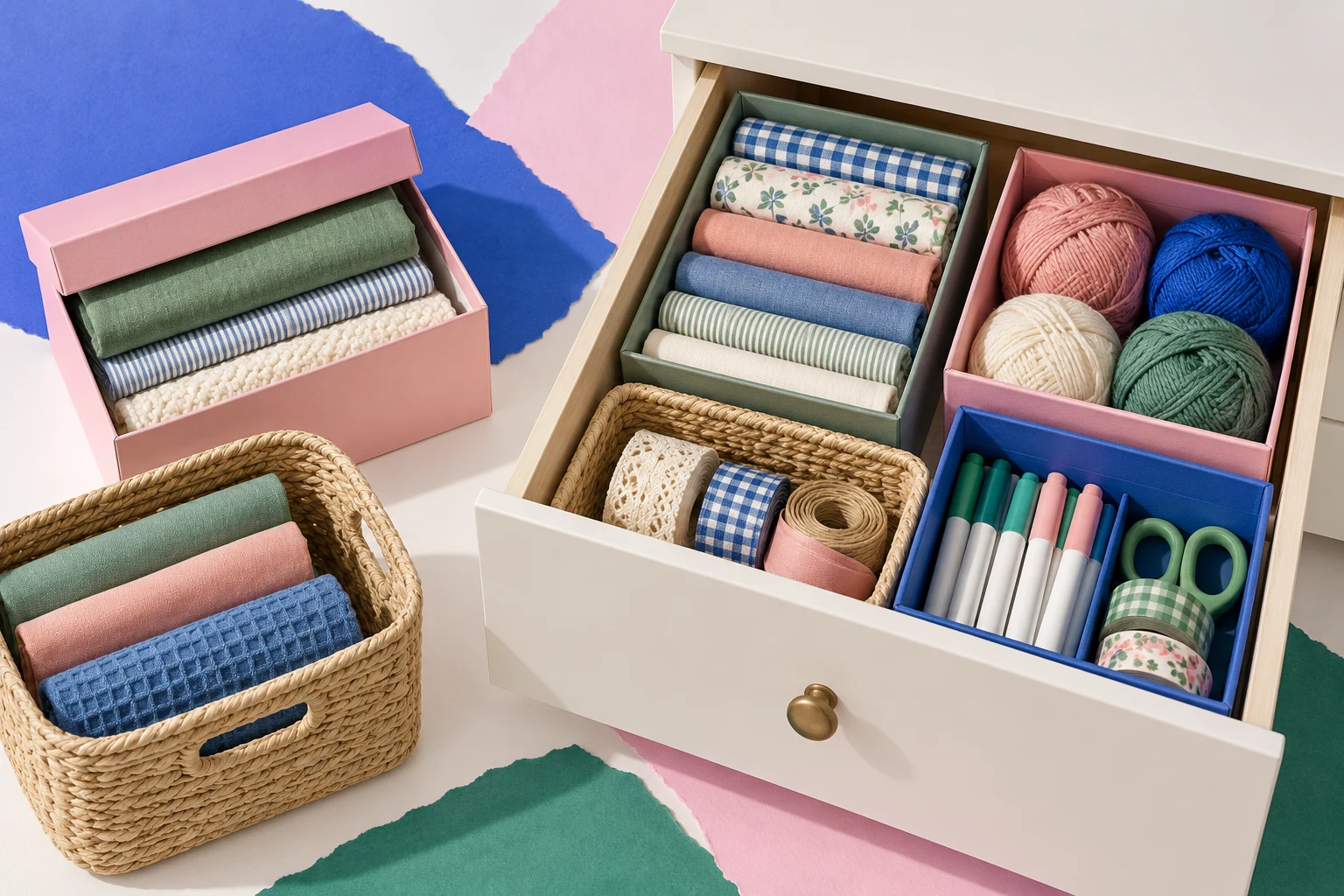
I love a pretty organizing container. But before you buy another bin, see what you can do with the boxes, baskets, and drawers you already have.
Buying containers before figuring out what needs to go in them can leave you with another thing to store. Start with one small space and try what fits. A bathroom drawer counts. So does the junk drawer. You don't have to tackle your entire house this weekend.
Give your stuff a space budget
Decide what space you're working with and what needs to share it.
If all your craft supplies need to fit on one 4-by-4 bookshelf, that's your space budget. You get to decide how much of it goes to yarn, markers, fabric, or whatever else you love.
If you have room for ten shoe boxes of markers sorted by color and saturation, enjoy every one of them. If you have room for one, pick the markers you actually want to use.
There's no universal right amount. There is an amount that fits your space and your life.
Shop your home first
Gather shoe boxes, shipping boxes, jewelry boxes, baskets, trays, and bins. Empty one manageable space, group the contents, and experiment.
You don't need to measure every container. Put it in the drawer or on the shelf and see what happens. Can you get it out? Can you reach what's inside? Does it hold what you need it to hold?
Seed beads need small containers or divided compartments. A big yarn collection might work in a 20-gallon bin, provided you can reach it easily. Match the container to the contents.
Once you've chosen how much space a category gets, let that be the limit. Keep your favorites. Release the overflow.
And if you're keeping something only because you spent money on it, remember: the money was spent. Keeping markers you never use won't bring it back. Maybe someone else would love them. Ask a teacher whether their classroom could use the extras.
Make putting things away easy
I admire people who maintain beautifully detailed systems. I also know myself. The more steps it takes to put something away, the less likely I am to do it.
Most of my makeup goes together. Lip gloss gets its own spot because that's how I use it. Your categories can be as broad or as detailed as you'll realistically maintain.
A broom you use ten times a day shouldn't live behind an ironing board you use once a quarter. Give frequently used things the easiest access. Try the setup when you're tired, too. Can you still put things away?
Then make it yours
Once it works, decide whether you want matching labels, colors, ribbon, or no labels at all. Wrap cardboard boxes inside and out with contact paper to decorate them and help them hold up better. Children can use picture labels before they can read; a photo of the contents works well.
If shifting containers bother you, try nonslip shelf liner or hook-and-loop strips. Dried beads of hot glue on a container's bottom can provide grip; hot glue can also join suitable bins together. Check material compatibility and test first. Personally, I like to rearrange, so I usually just deal with the shifting.
Still need a container? Take your space dimensions and a tape measure to the thrift store. Look for something clean, sturdy, and suited to what you're storing. If you buy new, check the opening as well as the available width, depth, and height.
Start with one shelf or drawer. Save the closet for a weekend when you have more time. Then rinse and repeat wherever you need a system that works better for you.
Try it: .